




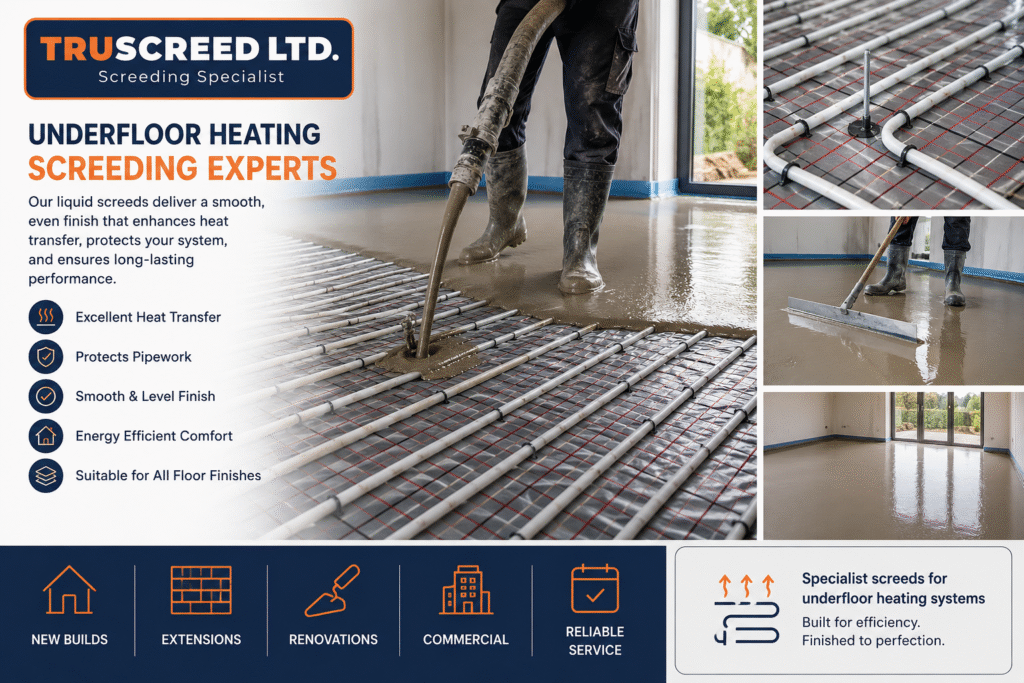
Underfloor heating is becoming an increasingly popular choice for modern homes, extensions, renovations and commercial developments. However, installing a high-quality heating system is only part of the process. To achieve efficient heat distribution and a reliable finished floor, choosing the right underfloor heating screed is equally important.
At Tru Screed, we understand the technical requirements involved in combining screeding with underfloor heating systems. Our liquid screeds create a smooth and even layer around the heating pipes, helping transfer heat effectively while providing a strong, level base for the final floor finish.
Whether you are planning a new-build property, renovation or commercial development, professional screeding can play an important role in the performance and longevity of your underfloor heating system.
Why Screed Is Important for Underfloor Heating
Underfloor heating works by distributing warmth across the floor rather than relying on individual radiators positioned around a room. For the system to perform effectively, heat needs to transfer evenly from the pipes into the floor above.
This is where underfloor heating screed becomes important.
The screed surrounds the heating pipes and creates a continuous layer through which heat can travel. Correct installation helps minimise gaps around the pipework while creating an even surface ready for the subsequent flooring stages.
A professionally installed screed can help provide:
- Consistent heat distribution across the floor
- Good contact around underfloor heating pipes
- A smooth and level surface
- Protection for heating pipework
- Efficient transfer of heat into the room
- A suitable base for various floor finishes
- Reliable performance over the long term
The screed therefore forms an important connection between the heating installation and the finished floor.
Why Liquid Screed Works Well with Underfloor Heating
Liquid screed for underfloor heating offers several practical advantages because of its flowing consistency.
When installed correctly, the material flows around the heating pipes and into the surrounding areas. This can provide excellent contact with the pipework and reduce unwanted voids.
Good contact is particularly important because air gaps can interfere with efficient heat transfer.
Liquid screed can also provide excellent surface regularity, making it an attractive solution for projects where both thermal performance and a high-quality floor base are required.
Improving Heat Transfer Through the Floor
The effectiveness of underfloor heating depends partly on how successfully heat travels from the pipework through the floor construction.
A correctly specified and installed underfloor heating screed helps create an effective thermal connection around the pipes.
Instead of having isolated areas of heat, the screed helps spread thermal energy across the floor area.
This can contribute to:
- More even floor temperatures
- Improved distribution of warmth
- Efficient operation of the heating system
- Fewer noticeable hot and cold areas
- Comfortable room temperatures
The complete performance will naturally depend on the overall heating design, insulation, floor covering and other construction details as well.
Protecting Underfloor Heating Pipework
Heating pipes form an essential part of a wet underfloor heating system and need to remain appropriately positioned during the screeding process.
The screed encapsulates the pipes, creating a stable surrounding layer once the material has cured.
Careful installation is essential. The screeding contractor needs to understand that the floor contains a heating system rather than treating it as an ordinary floor construction.
At Tru Screed, we specialise in screeding applications that work alongside underfloor heating, allowing the requirements of the pipework and finished floor to be considered throughout the project.
The Importance of Even Coverage
Uniform screed coverage can contribute significantly to the performance of an underfloor heating installation.
Inconsistent depths or poorly filled areas can potentially influence heat distribution and the quality of the finished floor.
Liquid screed is particularly effective at flowing around pipes and across larger floor areas.
Professional installation focuses on achieving:
- Appropriate screed depth
- Consistent coverage
- Good pipe encapsulation
- Accurate floor levels
- A smooth finished surface
- Proper preparation before installation
Each of these factors contributes to the overall quality of the floor construction.
Underfloor Heating and Energy Efficiency
One reason homeowners and developers choose underfloor heating is its potential to provide comfortable, evenly distributed warmth.
Rather than concentrating heat around radiators, the floor becomes a large heat-emitting surface.
However, efficiency depends on the system being designed and installed correctly as a whole.
A suitable screed for underfloor heating can support efficient performance by helping transfer heat from the pipework through the floor.
Other important factors include insulation, system controls, heating design and the final floor covering.
Creating a Comfortable Indoor Environment
Comfort is about more than simply achieving a particular room temperature.
Underfloor heating can create a pleasant environment because warmth is distributed across a broad floor area.
A well-installed screed supports this by helping spread heat consistently.
Potential advantages of a properly designed system include:
- Even warmth across the room
- Comfortable floor temperatures
- Reduced dependence on wall-mounted radiators
- Greater flexibility when arranging furniture
- Clean and uncluttered interiors
- Suitable heating for a variety of room layouts
For modern open-plan properties, this can be particularly appealing.
Preparing for Underfloor Heating Screed
Preparation is a crucial part of any screeding project.
Before the screed is installed, the underlying floor construction and heating system need to be appropriately prepared. Pipework should be correctly positioned and secured so that it remains in place during installation.
Depending on the project specification, preparation may involve checking:
- Floor insulation
- Underfloor heating pipework
- Pipe fixing and positioning
- Perimeter details
- Floor levels
- Required screed depth
- Heating zones
- Site accessibility
- Project specifications
Identifying potential issues before screeding begins can help avoid complications later.
Correct Screed Depth Matters
Screed thickness is an important technical consideration when installing a floor over underfloor heating.
The required depth will depend on factors such as the screed product, floor construction, heating system and project specification.
Using an unnecessarily thick layer may influence heating response, while insufficient coverage could compromise the floor construction.
There is therefore no universal depth that should simply be applied to every project.
Professional assessment and adherence to the selected screed manufacturer’s technical requirements are essential.
What Happens During Liquid Screed Installation?
The exact process depends on the site and screed system, but a professional liquid screed installation generally begins with careful preparation.
Once the area is ready, the screed can be pumped into the required space and distributed across the floor.
Typical stages may include:
- Checking the prepared floor
- Confirming required levels
- Inspecting heating pipework
- Preparing access for installation
- Pumping the liquid screed
- Distributing material evenly
- Achieving the specified floor level
- Finishing the surface appropriately
- Allowing suitable drying and curing
Following the correct installation procedure is essential for achieving the intended result.
Liquid Screed for Large Floor Areas
Liquid screed can be particularly useful for larger residential and commercial projects.
Its flowing nature allows the material to be pumped and distributed efficiently across substantial areas.
This can make it suitable for:
- New-build houses
- Home extensions
- Renovation projects
- Apartment developments
- Offices
- Commercial properties
- Large open-plan interiors
- Housing developments
The exact suitability of a screed should always be determined according to the individual project specification.
Underfloor Heating in New-Build Homes
New-build projects provide an excellent opportunity to integrate underfloor heating into the floor construction from the beginning.
Because the heating, insulation and screeding requirements can be considered during the planning stages, different components can be designed to work together.
Using liquid screed with underfloor heating can provide an efficient way of creating a smooth floor while encapsulating the heating pipework.
Early coordination between contractors can also help prevent delays and misunderstandings during construction.
Screeding for Home Extensions
Extensions are another common situation where underfloor heating may be installed.
Homeowners often want an extension to provide a comfortable modern living space, particularly for kitchens, dining areas and open-plan family rooms.
Underfloor heating eliminates the need to allocate as much wall space to radiators, potentially providing greater flexibility for interior layouts.
Professional screeding can then create a suitable surface above the heating system ready for subsequent flooring work.
Underfloor Heating for Renovations
Installing underfloor heating as part of a renovation can require careful planning because existing floor levels and construction details need to be considered.
Before selecting a screed system, the complete floor build-up should be assessed.
Important considerations can include:
- Existing floor condition
- Available floor depth
- Insulation requirements
- Heating system specification
- Final floor height
- Door thresholds
- Adjacent rooms
- Intended floor covering
Planning these details before installation can help create a better finished result.
Drying and Curing the Screed
After installation, the screed needs sufficient time to dry and cure according to the specific product and site conditions.
Trying to accelerate subsequent construction stages without considering drying requirements can create problems.
Drying can be influenced by:
- Screed type
- Screed thickness
- Temperature
- Ventilation
- Humidity
- Site conditions
Always follow the technical guidance applicable to the particular screed product being used.
When Can Underfloor Heating Be Switched On?
One of the most important stages after screeding is commissioning the heating system.
Underfloor heating should not simply be switched to full temperature immediately after screed installation. The screed must first reach the appropriate stage of curing or drying specified for the product.
Once permitted, commissioning generally involves increasing the system temperature gradually according to the relevant instructions.
This controlled process helps the floor adapt to temperature changes.
The exact commissioning schedule should always follow the screed manufacturer’s requirements and the heating system specification.
Choosing a Final Floor Covering
Different types of flooring can be used with underfloor heating, provided they are suitable for the system and installed according to the appropriate requirements.
Possible finishes may include:
- Tiles
- Stone
- Engineered timber
- Suitable laminate
- Suitable vinyl flooring
- Carpet systems designed for underfloor heating
Different materials transfer heat differently, so thermal resistance and manufacturer recommendations should be considered when selecting the finished flooring.
The floor covering, adhesive and underlay should all be compatible with the heating system.
Avoiding Common Screeding Problems
Good planning can prevent many issues associated with heated floor construction.
Common mistakes can include inadequate preparation, incorrect levels, poorly secured pipework or failing to follow drying and commissioning requirements.
A professional approach should focus on:
- Correct preparation
- Suitable screed specification
- Appropriate floor depths
- Secure heating pipes
- Consistent installation
- Controlled drying
- Correct heating commissioning
- Coordination with flooring contractors
Treating screeding as an integral part of the underfloor heating system rather than a separate task can help achieve a better overall result.
Why Experience Matters
Installing screed over underfloor heating requires an understanding of both flooring and heating considerations.
The contractor needs to recognise how screed depth, pipe coverage, preparation and drying can influence the completed installation.
Working with an experienced screeding contractor can help ensure the floor is approached according to its technical requirements.
At Tru Screed, we specialise in delivering screed solutions that integrate effectively with underfloor heating systems.
Why Choose Tru Screed?
At Tru Screed, we understand that a heated floor needs more than simply a smooth surface.
Our approach focuses on providing professionally installed screeds designed to work effectively with the heating system underneath.
Customers choose us for:
- Specialist knowledge of underfloor heating screed
- Professional liquid screed installation
- Careful attention to floor levels
- Effective encapsulation of heating pipework
- Smooth and even finishes
- Solutions for residential and commercial projects
- Technical understanding of heated floor construction
- A focus on quality and long-term performance
Our aim is to provide a screed installation that supports the efficiency, comfort and reliability expected from a modern underfloor heating system.
Professional Underfloor Heating Screed from Tru Screed
A successful underfloor heating project depends on several components working together. Insulation, heating pipes, controls, screed and the final floor covering all contribute to the finished system.
Choosing an appropriate underfloor heating screed is therefore an important part of the project.
At Tru Screed, our liquid screeds provide smooth and even coverage around heating pipework, helping support efficient heat transfer while creating a high-quality base for the finished floor.
Whether you are working on a new build, extension, renovation or commercial development, our specialist screeding knowledge can help you achieve a floor designed around both performance and longevity.
With careful preparation, professional installation and the right screed specification, underfloor heating can deliver comfortable and efficient warmth while remaining discreetly integrated beneath your finished floor.

