




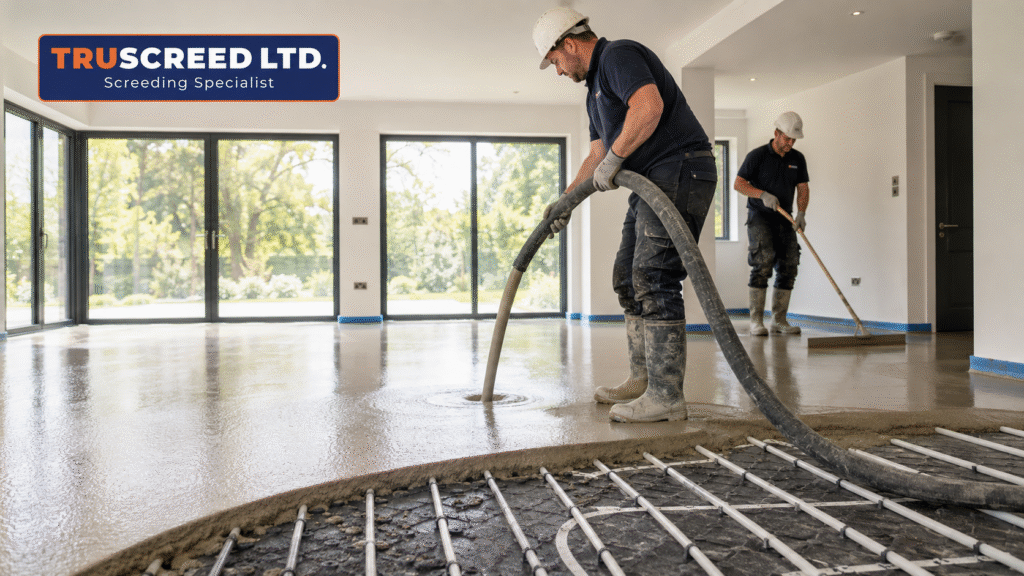
A strong, smooth and level floor begins with the correct screed. Whether a project involves a domestic extension, new-build property, renovation or large commercial fit-out, the screed creates the essential base required for the final floor finish.
Traditional screeding methods remain suitable for certain projects, but liquid floor screed has become increasingly popular because of its speed, accuracy and ability to flow evenly across large areas. It can provide a high-quality surface while surrounding underfloor heating pipes effectively and reducing the amount of manual levelling required.
At Tru Screed, we provide tailored liquid floor screeding solutions for domestic and commercial projects. Our experienced team uses modern materials and application techniques to deliver smooth, durable and accurately levelled results.
What Is Liquid Floor Screed?
Liquid floor screed is a flowing material installed over a prepared subfloor, insulation or underfloor heating system. Unlike traditional sand and cement screed, which is mixed to a semi-dry consistency and levelled manually, liquid screed can be pumped directly into the required area.
Its fluid consistency allows it to spread efficiently and fill gaps around pipes, corners and other floor details. The material is then levelled to the specified depth using specialist equipment.
Once cured and prepared correctly, the screed provides a suitable base for floor finishes such as:
- Tiles
- Carpet
- Vinyl
- Engineered timber
- Laminate flooring
- Resin systems
- Other compatible finishes
The final floor covering should only be installed once the screed has reached the required moisture level and any necessary surface preparation has been completed.
Main Types of Liquid Floor Screed
The correct screed depends on the building, programme, floor finish and environmental conditions. The two common categories are calcium sulphate screed and cement-based liquid screed.
Calcium Sulphate Screed
Calcium sulphate screed, sometimes called anhydrite screed, is widely used in domestic and commercial interiors. It offers excellent flow characteristics and can be installed across large areas with fewer joints than many traditional screeds.
It is particularly effective when used with underfloor heating because it flows closely around the pipes, helping to reduce air pockets and improve heat transfer.
However, calcium sulphate screed must be protected from prolonged moisture exposure. It may also require the removal of surface laitance before adhesives or floor coverings are applied.
Cement-Based Liquid Screed
Cement-based flowing screed combines the convenience of pumped installation with cement-based technology. Depending on the selected product, it may be suitable for environments where moisture resistance or compatibility with cement-based adhesives is particularly important.
Different formulations have different drying times, strength ratings and minimum installation depths. Product specifications should always be reviewed before a screed is selected.
Benefits of Liquid Floor Screeding
Liquid screed offers several advantages when correctly specified and professionally installed.
Fast Installation
Because the material is delivered and pumped into position, sizeable floor areas can often be completed efficiently. This can help reduce labour time and support demanding construction programmes.
Smooth and Level Results
The flowing consistency allows the screed to settle evenly across the prepared area. Accurate level checks during installation help create a consistent surface ready for the next stage of the project.
Reduced Screed Depth
Some liquid screed systems can be installed at a lower depth than conventional sand and cement screed. This can reduce the overall floor build-up and may lower the weight placed on the structure.
The permitted depth depends on the product, substrate, loading requirements and whether underfloor heating is present.
Fewer Joints
Liquid screed can often cover larger areas with fewer movement joints. This provides greater design flexibility, although joints may still be required around structural breaks, changes in floor shape or other specified locations.
Efficient Pumped Application
Pumping allows the material to reach areas that may be difficult to serve using manual methods. It also reduces the repeated movement of screed through the property by wheelbarrow.
Consistent Material Quality
Factory-produced screed is mixed according to controlled specifications before delivery. This helps provide more consistent material properties across the installation.
Liquid Screed and Underfloor Heating
Underfloor heating works most effectively when the heating pipes are surrounded by a material that distributes heat evenly. Liquid screed flows around the pipes and creates close contact with the system.
This offers several potential benefits:
- Reduced air pockets around the pipes
- More even heat distribution
- Efficient transfer of warmth into the room
- Lower screed depths with compatible systems
- A smooth base for the chosen floor covering
- Good coverage across complex heating layouts
Before screeding begins, the underfloor heating pipes must be secured firmly. Loose or poorly fixed pipes may move or float when the liquid material is pumped into the room.
The system should also be pressure-tested before installation. Heating must not be activated immediately after screeding; the specified curing and commissioning procedure should be followed carefully.
Where Can Liquid Screed Be Used?
Liquid floor screeding is suitable for many types of development, including:
- New-build houses
- Home extensions
- Renovation projects
- Flats and apartment buildings
- Offices and commercial premises
- Retail units and showrooms
- Schools and healthcare facilities
- Warehouses and industrial buildings
- Hotels and hospitality properties
- Large underfloor heating installations
The intended use of the building affects the required screed strength, depth and finish. A domestic bedroom and a busy commercial area will not necessarily require the same specification.
Preparing a Floor for Liquid Screed
Successful screeding begins with thorough preparation. Problems beneath the screed may affect its thickness, levels or long-term performance.
The preparation process may include:
- Cleaning the subfloor and removing loose debris.
- Installing insulation to the required depth.
- Laying a suitable damp-proof or separating membrane.
- Sealing joints and penetrations to prevent leakage.
- Fitting perimeter edging strips.
- Installing and securing underfloor heating pipes.
- Pressure-testing the heating system.
- Establishing accurate finished floor levels.
- Confirming the required screed depth.
- Checking access for the delivery and pumping equipment.
Liquid screed can escape through very small gaps, so membranes and joints must be sealed carefully. The area should also be protected from unnecessary access during installation and initial curing.
The Liquid Screed Installation Process
Before pouring begins, the installation team checks the prepared floor, specified levels and site conditions. The liquid screed is delivered in a ready-mixed form and tested where required before being pumped into the building.
The material is distributed systematically across the floor and brought to the correct depth. A specialist levelling bar is passed through the screed to help remove trapped air and produce an even surface.
After installation, the area should remain undisturbed for the recommended initial period. Ventilation is then introduced according to the product guidance to support controlled drying.
The floor must not be loaded, covered or exposed to unsuitable conditions too early. Following the correct aftercare instructions helps protect the quality of the finished screed.
Drying and Preparing for Floor Finishes
A screed may feel firm enough to walk on before it is dry enough to receive its final floor covering. Installing impermeable flooring or adhesive too soon can trap moisture and lead to failure.
Drying time depends on several factors, including:
- Screed type and thickness
- Temperature and ventilation
- Humidity within the building
- Size and layout of the floor
- Underfloor heating
- Manufacturer’s product specification
- Site conditions after installation
Moisture testing should be completed using a method suitable for the screed and chosen floor finish.
Calcium sulphate screeds may develop a weak surface layer known as laitance. This generally needs to be removed by sanding before primers, adhesives or finishes are applied. The surface should then be cleaned thoroughly.
Choosing a Professional Floor Screeding Contractor
Liquid screeding requires accurate preparation, suitable materials and experienced installation. Incorrect levels, inadequate sealing or poor aftercare can delay later trades and increase project costs.
A professional contractor should assess the project requirements, advise on an appropriate screed and coordinate the installation with builders, underfloor heating specialists and flooring contractors.
Tru Screed offers a full range of liquid floor screeding options designed for speed, strength and precision. From domestic extensions to large commercial fit-outs, we provide tailored solutions that create a high-quality, level surface ready for compatible final floor finishes.
Contact Tru Screed today to discuss your project, request professional advice and arrange a quotation for your liquid floor screeding requirements.

